

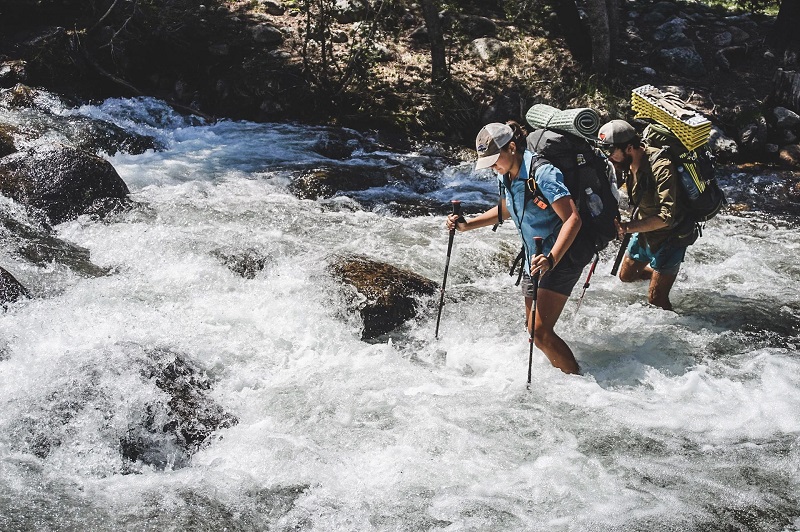
Few features in the backcountry command more respect than an unbridged river running high. Trails often terminate abruptly at the water’s edge, presenting hikers with a stark psychological dilemma. After hiking fifteen miles under a heavy pack, the urge to cross is intensely compelling. Turning back means abandoning mileage, altering permits, or admitting defeat to an inanimate obstacle.
That mindset is precisely what leads experienced wilderness travelers into trouble. Moving water exerts exponential force against the human body; doubling the speed of a current quadruples its physical pressure. What appears to be an innocent, knee-deep crossing on a topographic map can transform into an inescapable hydraulic trap in a matter of seconds. Negotiating a backcountry river safely requires setting aside itinerary pressure, systematically reading the hydrological clues written across the water’s surface, and maintaining the discipline to turn around when the river demands it.
Reading the Hydrology: Decoding Surface Signals
Water always takes the path of least resistance, and the surface of a river acts as a dynamic map of what lies beneath. Before touching the water with a boot, you must study the hydraulic features from the bank.
A common mistake is mistaking smooth water for safe water. Glassy, unbroken surfaces often indicate deep, fast-moving channels where the volume is concentrated into a narrow trench. Conversely, choppy water with small, uniform ripples often marks a shallower gravel bed where the energy of the river is dispersed across a wider plane.
Pay close attention to surface shapes:
- Downstream V-formations: When ripples form a V pointing downstream, water is funneling into a deeper, accelerated chute between two obstructions. While this water is often free of surface rocks, it holds immense velocity and volume, making it dangerous to ford.
- Upstream V-formations: A V pointing upstream indicates a submerged obstacle—usually a boulder or submerged log—pushing back against the current. The water mounds up into a pillow directly in front of the rock before parting around it.
- Eddies: Behind large boulders or pronounced bends, water slows, swirls, and temporarily flows back upstream. These calm pockets can serve as resting points during a wide crossing, provided the transition zone between the main current and the eddy is not violent enough to compromise your footing.
Water clarity also tells a critical story. If a stream is milky or silty—typical of active glacial runoff—you cannot assess foot placement or bottom contours visually. You must rely entirely on trekking poles to probe for drop-offs, wedging cracks, and shifting boulders. Furthermore, listen closely. If you hear the dull, rhythmic thud of rocks rolling along the riverbed, the bottom current is traveling with catastrophic force, regardless of how calm the upper layers appear.
Selecting the Crossing Point: Geometry and Hazards
The trail crossing is rarely the best place to enter the water. Over decades, foot traffic degrades banks, creating steep mud walls, while the confined river channel deepens from concentrated erosion. Upstream or downstream exploration almost always reveals superior alternatives.
Look for areas where the river widens and splits into multiple shallow channels, known as a braided stream. Crossing three separate calf-deep channels is infinitely safer than attempting a single, compressed riverbed. Straight stretches of river with uniform gravel or small cobble bottoms are far preferable to outer bends, where centrifugal force carves deep trenches and undermines the opposite bank.
Equally important is assessing your downstream runout. Before committing to a ford, ask yourself a single question: If you lose your footing and get swept away, what will happen?
If the water empties into a calm, shallow gravel bar fifty yards downstream, the objective danger is low. However, if the current sweeps directly toward a strainer—a downed tree, a root ball, or a debris jam—the crossing is strictly off-limits. Strainers act like colanders: water passes through freely, but a human body is pinned against the branches by hydraulic pressure, creating an immediate drowning hazard. Similarly, avoid crossings that lie directly above Class III or IV rapids, sheer canyon walls with no exit points, or waterfalls.
The Mechanics of a Safe Crossing
Executing a successful ford involves distinct physical techniques and specific gear configurations designed to mitigate risk if you slip.
Preparing Your Gear for Immediate Release
Before stepping into the current, unclip both your pack’s hip belt and your sternum strap. Loosen your shoulder straps so you can shed the load instantly. If you fall into swift water with your pack securely buckled, the buoyant foam of the bag will float to the surface, flipping you face-down while the heavy contents pin you beneath the waterline. You must be able to jettison the pack in half a second.
Never attempt a serious backcountry crossing barefoot or in flimsy sandals. Cold water rapidly numbs your feet, dulling your sensory feedback and leaving you vulnerable to sharp rocks or foot entrapment. Keep your primary hiking shoes or trail runners on, paired with thin synthetic socks. Wool socks become heavy and slip inside the shoe, while bare feet invite debilitating puncture wounds in the middle of nowhere.
Establishing Three Points of Contact
Cross using a wide, stable stance, facing slightly upstream or diagonally across the current. Angle your body so that the water glances off your thigh rather than hitting you broadside, which maximizes your surface area and knocks you off balance.
Use two trekking poles—or a stout, six-foot wooden staff found on the bank—to maintain constant three-point contact. Move only one limb at a time: plant both poles firmly, step laterally with your lead foot, settle your weight, and then bring your trailing foot forward. Never cross your legs while moving through current. Slide your feet along the bottom rather than lifting them high out of the water, which reduces the chance of having a foot swept out from under you.
Mutual Support Formations
If you are traveling in a group, mutual support dramatically increases stability. Two or three hikers can link arms tightly at the elbows or grasp the shoulder straps of the person beside them, forming a unified, wide-based tripod. The largest or strongest individual should take the upstream position to break the primary force of the current, creating an eddy behind them that makes footing significantly easier for the hikers directly downstream.
Factoring in Diurnal and Weather Cycles
In mountainous terrain, rivers are living systems governed by temperature and weather patterns miles upstream.
Glacial streams and snowmelt-fed rivers exhibit pronounced diurnal variations. In early morning, following cold alpine nights, runoff slows to a trickle. By late afternoon, warm sunshine and melting snowpacks swell the same creeks into raging torrents. If you arrive at an intimidating river late in the day, the smartest tactical decision is often to set up camp on the near bank, get a warm meal, and cross early the following morning when water levels can be twelve to eighteen inches lower.
Rainfall changes the equation instantly. A localized thunderstorm over a high watershed can trigger flash flooding in downstream valleys hours later, long after the sky directly above you has cleared. If a creek turns sudden chocolate-brown, rises visibly against shoreline rocks, or begins carrying fresh forestry debris, retreat from the bank immediately.
The Hard Red Lines: When to Turn Around
A backcountry traveler must establish non-negotiable thresholds before emotion, fatigue, or schedule commitments cloud practical judgment.
Turn around or halt your crossing immediately if:
- The water rises above mid-thigh in moving current. Once water reaches your pelvic girdle, your body displaces enough volume to cause sudden, severe loss of negative buoyancy. Your feet lose traction, and the current easily sweeps you away.
- You cannot plant your trekking poles without them vibrating violently. If the current bends your aluminum or carbon poles backward, the water is moving too fast for human legs to resist.
- The substrate consists of greasy, bowling-ball-sized boulders. Navigating an uneven, shifting bed under heavy water pressure inevitably leads to an ankle twist or foot entrapment.
- There is a lethal downstream hazard with zero recovery margin. Never gamble against a logjam or a canyon drop.
Turning back is never an admission of failure; it is an exercise in basic wilderness competency. The mountain will still be there tomorrow, the trail will eventually dry out, and an intact hiker can always find an alternate route. Backcountry rivers do not negotiate, and understanding when to stop walking is the ultimate mark of an experienced traveler.